Let me tell you a little story about my dad.
At one time, he owned a Willys Jeep. I’m not entirely sure what year it was, but judging by the old photograph, I’d say it was sometime in the late 1960s.
In the picture, there’s a little blond-haired lad who I think is my brother Chris, with me sitting alongside him. Mum is behind the wheel, which is interesting in itself because, as far as I remember, she didn’t have a driving license at the time.
The photograph was taken at Park Hill Farm on a wonderful sunny 1960’s day.
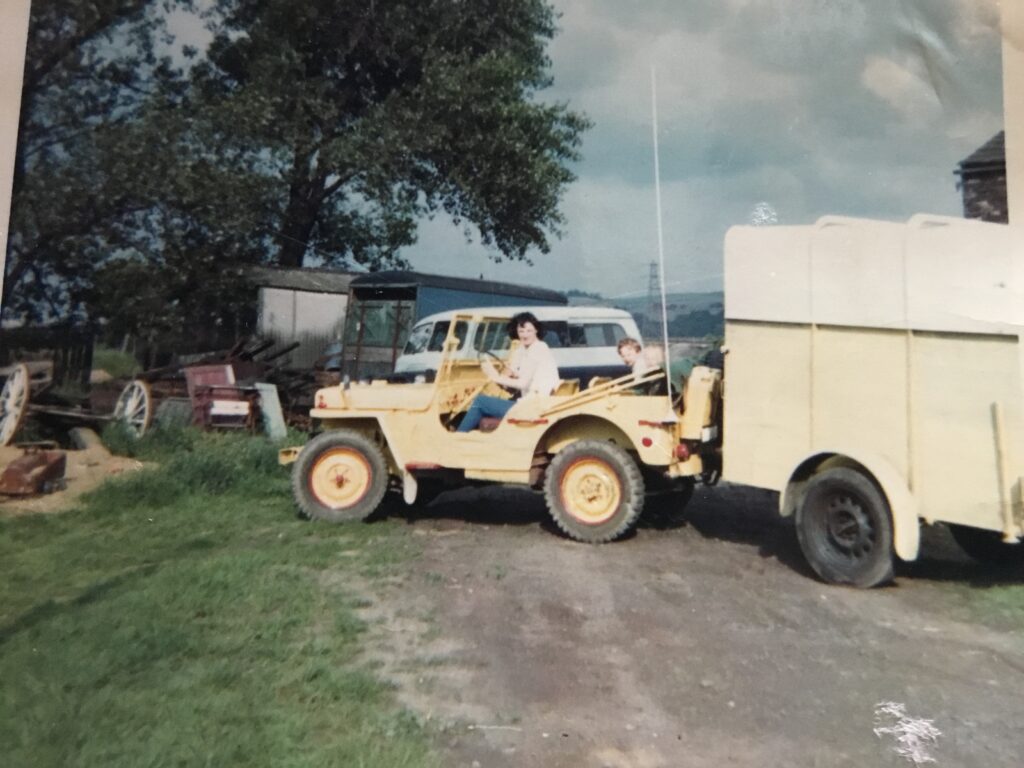
Dad had painted the Jeep bright yellow. Why yellow, I have absolutely no idea. Over the years, he seemed to acquire paint in all sorts of shades of green, yellow and red, and whatever happened to be available generally found its way onto something at Park Hill Farm.
Color coordination wasn’t necessarily a priority. If it needed painting and there was a tin available, that was usually good enough.
But it’s not the color of the Jeep that makes this story worth telling.
It’s the horsebox attached to the back.
Dad was never a man to let a useful piece of equipment stand idle. The Jeep and trailer were part of the everyday workings of Park Hill Farm, collecting kitchen waste from local restaurants and the early takeaway establishments around Wakefield.
The waste would be brought back to the farm and turned into swill to feed the pigs. The same trailer was also used to transport pigs to the local abattoir.
It was practical, economical and typical of the way Dad ran things. You made use of what you had, repaired what needed repairing and got on with the job.
Now, somewhere along the way, the Jeep and horsebox became the subject of a family story that has survived for more than half a century.
As the story has been told to me, Dad was driving along Westmorland Street in Wakefield, heading towards the Springs. Or possibly coming the other way.
Mum or Grandad may have been with him, although I can’t be certain about that either.
You can probably tell that this isn’t going to stand up particularly well under cross-examination.
What does seem to be agreed upon, however, is that at some point the horsebox became detached from the Jeep.
And decided to continue the journey on its own.
Now, anyone familiar with that part of Wakefield will know that the Springs is not somewhere you’d particularly want a runaway trailer gathering momentum.
But that’s apparently exactly what happened.
Off went the horsebox, heading downhill towards a pub at the bottom.
The pub, I’ve since discovered, was the Dolphin on Warrengate. It had been pulling pints under that name since at least the 1820s, and for a time it was listed as the New Dolphin. I wasn’t much of a beer drinker in the 1960s, so my knowledge of Wakefield’s licensed establishments was rather limited at the time.
The building later became the Wakey Tavern, and these days it’s part of the Six Chimneys, a Wetherspoons. So if you ever find yourself enjoying a pint there, spare a thought for the horsebox that very nearly got there first.
What I would have given to see the expressions on the faces of anyone watching a horsebox making its own way down the road!
Fortunately, as far as I know, nobody was injured, and I don’t believe the police were involved.
Quite how the horsebox eventually came to a halt, or how Dad managed to retrieve it, has been lost somewhere in the retelling.
I imagine there was a certain amount of head-scratching, followed by the practical business of getting everything back together and carrying on with the day.
That would have been Dad’s way.
I don’t tell this story to make fun of him. Quite the opposite.
When I think about Dad in those years, I remember just how hard he worked and how much ingenuity went into keeping Park Hill Farm running. Money wasn’t always plentiful, equipment was often second-hand, and there was usually something that needed fixing.
But he found a way.
The yellow Jeep, the horsebox and the collection of kitchen waste were all part of that life. It wasn’t glamorous, but it was honest work, and Dad was never afraid of getting his hands dirty.
Of course, when you’re running a farm, working with machinery, animals and whatever equipment you can lay your hands on, things don’t always go quite according to plan.
And occasionally, those mishaps become the stories that a family remembers long after the equipment itself has disappeared.
I don’t know what eventually happened to the yellow Jeep, or whether the horsebox ever attempted another independent journey through Wakefield.
But I do know that, more than fifty years later, the story still makes me smile.
And amongst our old family photographs is the evidence that the yellow Jeep really did exist.
As for the horsebox, I can only assume it was in a hurry to get to the pub.